
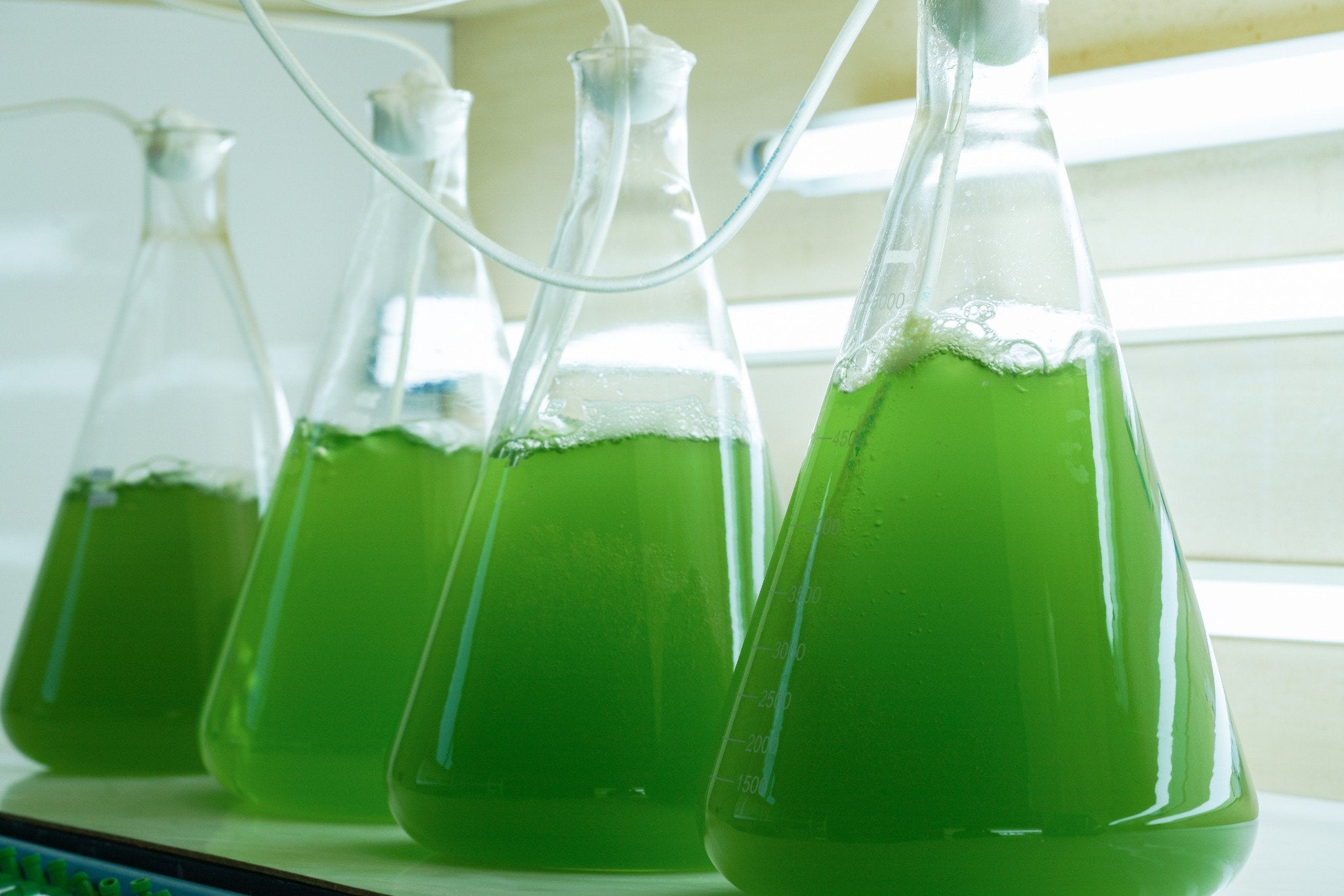
The algae that brings life into your space
Chlorella vulgaris is a powerful green alga known for its impressive ability to produce oxygen through photosynthesis. This microscopic powerhouse is being intensively researched, from CO₂ sequestration and indoor air quality to life support systems for space travel.
The science behind Chlorella vulgaris
Like all plants, Chlorella vulgaris uses photosynthesis to convert carbon dioxide into oxygen. However, it does so with exceptionally high efficiency: every single cell performs photosynthesis; there are no roots, stems, or leaves that need to be supported. Per unit of biomass, microalgae can therefore sequester many times more CO₂ compared to land plants; laboratory studies have measured rates 10 to 50 times higher¹. In a controlled environment such as a photobioreactor, Chlorella thrives by absorbing CO₂ and releasing oxygen.
What studies show about Chlorella and indoor air
A 2023 study compared Chlorella vulgaris in a test chamber directly with classic air purification methods, such as HEPA filters and activated carbon². The result: the microalgae completely removed formaldehyde and volatile organic compounds (VOCs) and additionally captured fine particulate matter (PM2.5 and PM10). Unlike filters, they also increased oxygen levels and humidity. The researchers concluded that microalgae, especially Chlorella vulgaris, can break down indoor pollutants more efficiently than the physical methods compared.
These results come from a test chamber under controlled conditions. The strength of the effect in a real living space depends on room size, air exchange, light levels, and cell density.
What makes Chlorella vulgaris special
Oxygen production: Chlorella vulgaris binds carbon dioxide and releases oxygen, visible as fine bubbles rising in the culture under good light.
Living system: Unlike a technical device, the culture grows, changes, and reacts to light and care.
Compact and simple: Our photobioreactors bring Chlorella vulgaris into your home or office, without large installations, needing only a few drops of nutrients every few weeks.
Bringing fresh air into your home
Chlorella vulgaris combines the power of nature with modern technology. Its ability to produce oxygen makes it a fascinating addition to any room—living, growing, and a little different every day.
¹ Review article in Frontiers in Bioengineering and Biotechnology, 2024: https://www.frontiersin.org/journals/bioengineering-and-biotechnology/articles/10.3389/fbioe.2024.1387519/full
² Wang et al., Environmental Science and Pollution Research 30, 2023: https://link.springer.com/article/10.1007/s11356-023-25799-8